
How to design personal training packages
01 September 2022

If you’re new to the fitness industry, it can be difficult to know how to create personal training packages that sell.
Building a client base is difficult when you’re just starting, and it can still be challenging even with a few years of experience.
After all, marketing and selling your services is time-consuming and a different skill altogether compared to coaching your clients’ fitness.
Here you’ll find everything you need to build your client base and boost retention. You can kill two birds with one stone through your pricing structure when you know the right method.
1. Know your personal training niche
Nothing is more important than defining your unique selling point when developing personal training pricing packages.
Knowing the niche fitness market you’re targeting means you can build your packages with your client base in mind.
This means they’ll be better suited to your potential clients, who will then be more likely to sign up for your services.
If you present a general pricing structure that doesn’t include a variety of services or extras to benefit from, clients won’t see the value in what you’re selling.
Generic block sessions
Generic PT block sessions carry an end date and a potential gap in your income if clients decide not to rebook when their sessions end.
That’s not to say this can’t be a successful business model if you have plenty of potential clients in your area and you’re happy to put a lot of work into reselling your services.
But breaking packages up and zoning in on a particular group of potential clients can make your life a lot easier and significantly boost your income.
If you want to secure a long-standing client base that doesn’t require constant reselling, then let’s look at an alternative pricing structure.
Splitting up into niches with long term goals
In this case, you would set out a monthly payment subscription depending on the number of weekly or monthly sessions a client would get.
Best practise for this would include information about what a client would gain from their sessions and specific package. Here, you can tailor packages to different clientele or your specific niche.
Presenting packages in this way means that clients know what they will get out of their session with a long-term goal in mind.
Many PTs are beginning to see the value in this kind of business model. Not only does having a niche bring in more clients, contrary to popular belief, but it truly boosts retention when they can’t find such specialised advice elsewhere.
To find your niche, try this simple process:
⦁ analyse your competitors
⦁ identify a gap in the market
⦁ research this ‘gap’
⦁ establish and market yourself as the go-to expert on this topic
There’s obviously some hard work involved in following this, but the steps are simple when you break them down.
2. Demonstrate value
Following on from our point above, it’s important to communicate the value of your services to potential clients.
While this includes specialist knowledge in your chosen area, you can make your personal training packages even more appealing by throwing in extra perks.
This is less about fitness and more about selling your services to clients. After all, you’re running a business, and you need to tap into your sales knowledge at times if you want it to be successful.
So, what extra value can you add to your personal trainer packages once you’ve chosen an area of the market to specialise in?
Here are some ideas:
⦁ free nutrition advice
⦁ free access to bootcamps
⦁ free group training sessions
⦁ protein powder/supplements
⦁ fitness journal
⦁ meal prep kit
The word ‘free’ will draw the attention of potential clients, as they’ll feel they’re getting more for their money.
Offering these additional services will be cost-effective for you and require little effort on top of your main service. So, it won’t affect your profit from signing new clients up.
Adding extra value to your services on top of your unique selling point creates a personalised selection of personal training packages for your potential clients.
This places you way ahead of competitors, especially if you’re operating in your local area rather than online.
Chances are many of them are selling block sessions or short-term bootcamps aimed at the general public, and they’re unaware of how they could improve their business model.
3. Create your personal training packages
Now that you know what makes personal training packages successful, it’s time to create your own.
We’ve put together two examples to help you out based on everything we’ve discussed. Feel free to use them as a template when designing your own, and don’t forget to check out our tips on selling your packages below.
Examples of strong personal training packages:
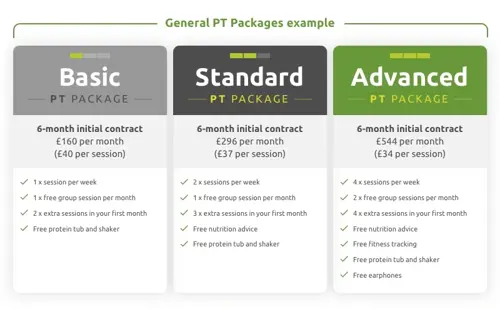
Notice how the price per session becomes lower as the monthly amount increases.
This draws attention to the fact the client is getting a better deal by spending more per month and encourages them to opt for the higher price.
The number of free services and gifts increases with the price, too, even though the client is technically only paying for the sessions. You should keep these extras valuable to the client yet minimal for yourself.
Here’s an example of how a set of packages targeted at pre and post-natal clients could look:
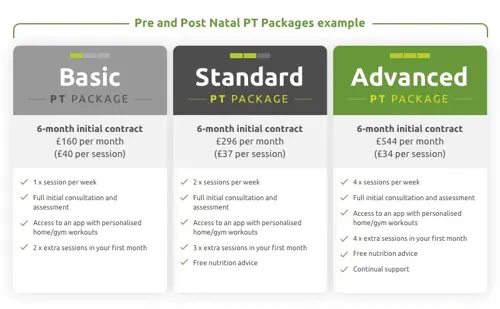
What you include in your packages will rely on your own areas of expertise and your target client base, but we hope these examples shed some light on what a strong and highly marketable pricing structure looks like.
Remember, never devalue your services by adding discounts to your actual prices.
They should always stay the same–your time is valuable and offering extra sessions or token gifts is a great way around signing clients up through discounts.
Although, offering a 10% discount to clients who pay in full for the 6-month minimum duration is a great tip. If a client pays in full for the Standard package at £296 per month, for example, that’s £1,776 on the spot.
This is great for you and makes your packages easier to sell without devaluing them if a client asks for a discount. But more on this below.
4. Tips for selling your personal training packages
The final step of creating your personal training packages is knowing how to sell them.
Effectively promote your packages
Once you’ve created your personal trainer price list, you need to get it in front of clients. Places you can display your pricing structure include:
⦁ your website
⦁ your social media pages
⦁ gym noticeboard
⦁ community noticeboards
⦁ local shop windows
While there are various promotion methods, you should focus on those most relevant to your business.
For example, if you’re operating mostly out of your local gym or a purpose-built client training area in your own home, you’ll want to focus on attracting potential clients in your area.
It would make more sense to partner with local businesses and spread the word of your services that way, rather than putting your efforts into online marketing.
However, this can still be useful if you stick to optimising your website and socials around location-based keywords.
On the other hand, it wouldn’t make much sense to focus on marketing to your local community if you’re looking to attract online clients. Instead, you would focus on growing traffic to your website and social channels using niche-specific keywords.
Another fool proof way of promoting your personal training packages that applies to all business models is through referrals.
Encouraging your clients to ‘refer a friend’ works extremely well, as it’s mutually beneficial. You gain more clients, and they benefit from incentives for promoting your services.
For example, you could offer £50 cash to clients who successfully refer a friend. That’s a huge incentive for them, and it’s a small price to pay for getting a new client signed up for a recurring monthly package.
Remember that the reward doesn’t need to be cash—you could offer any benefit you feel your client would value.
Create urgency when price presenting
This applies to in-person and online PTs and is perhaps one of the most important aspects of selling your personal training packages.
Implying that your product won’t be available with such a good deal in the future creates a sense of urgency and encourages potential clients to act fast.
It makes your services seem more desirable compared to competitors, especially if you do your research and make sure you present your packages this way. It will ultimately increase your sales rate.
But, how do you achieve this sense of urgency?
Setting a deadline for your offers is a fool proof way of signing up new clients on the spot.
It reduces the likelihood of a client making an excuse, such as ‘I need to speak with my partner first’ before signing up, which happens more often than you’d think.
For example, you could state, ‘I have an offer for the Advanced Package ending today. It’s 10% off if you pay in full, and I’m throwing in free nutrition advice as part of the plan.’
Or, if you’re promoting your packages online, incorporate this offer into the copy on your website or social media description.
This form of discount gives the client a push towards finalising the sale without you having to devalue your services, as reducing the monthly rate can significantly reduce your income and annoy other clients who are currently paying more.
If they pay in full for the Advanced Package at a monthly rate of £544 with a 10% discount, that’s £2,937 on the spot. Not bad for one client.
BONUS TIP: Using social proof to emphasise the value and popularity of your product is a great way to follow this up.
You could say, ‘twelve people have already signed up for this offer today, so you don’t want to miss out!’.
It would help if you also displayed testimonials and reviews across your website and social media channels, as this form of social proof is incredibly powerful for customers making a purchase decision.
Include a clear CTA
This is important if you’re promoting your personal training price list online.
Your CTA, or ‘call to action’ should be as clear as possible and direct potential clients straight to the point of contact.
Try not to use vague language such as ‘get in touch’. Instead, show them exactly how to contact you, so they don’t think twice before enquiring.
Here’s an example of a strong CTA to use on a social media post:
Want to get this offer before it ends? DM me today, or call (insert phone number), and I’ll get you signed up straight away.
From this, the clients know where and how to contact you, and that they need to do so promptly.
Specialist personal trainer insurance with Insure4Sport
Personal training is a hugely rewarding and lucrative career path, but things can go wrong. That’s why you may want to consider protecting yourself through insurance.
With Insure4Sport, specialist personal trainer insurance is designed to help financially protect you if your equipment is lost, damaged, or stolen or a client makes a claim against you.
Find out more or get a quote today.
Please note the information provided on this page should not be taken as advice and has been written as a matter of opinion. For more on insurance cover and policy wording, see our homepage.
Get a quick quote for Sports Insurance
Get A QuoteRelated Posts
Insure4Sport is a
 Insurance Services product


©Copyright Ripe Thinking Limited 2026.
Insure4Sport® is a registered trademark and a trading name of Ripe Insurance Services Limited which is Authorised and Regulated by the Financial Conduct Authority No.313411. Registered office: One Stockport Exchange, Railway Road, Stockport, United Kingdom, SK1 3SW. Registered in England No. 04507332.