
The 5 most common rock climbing injuries and how to avoid them
23 September 2025
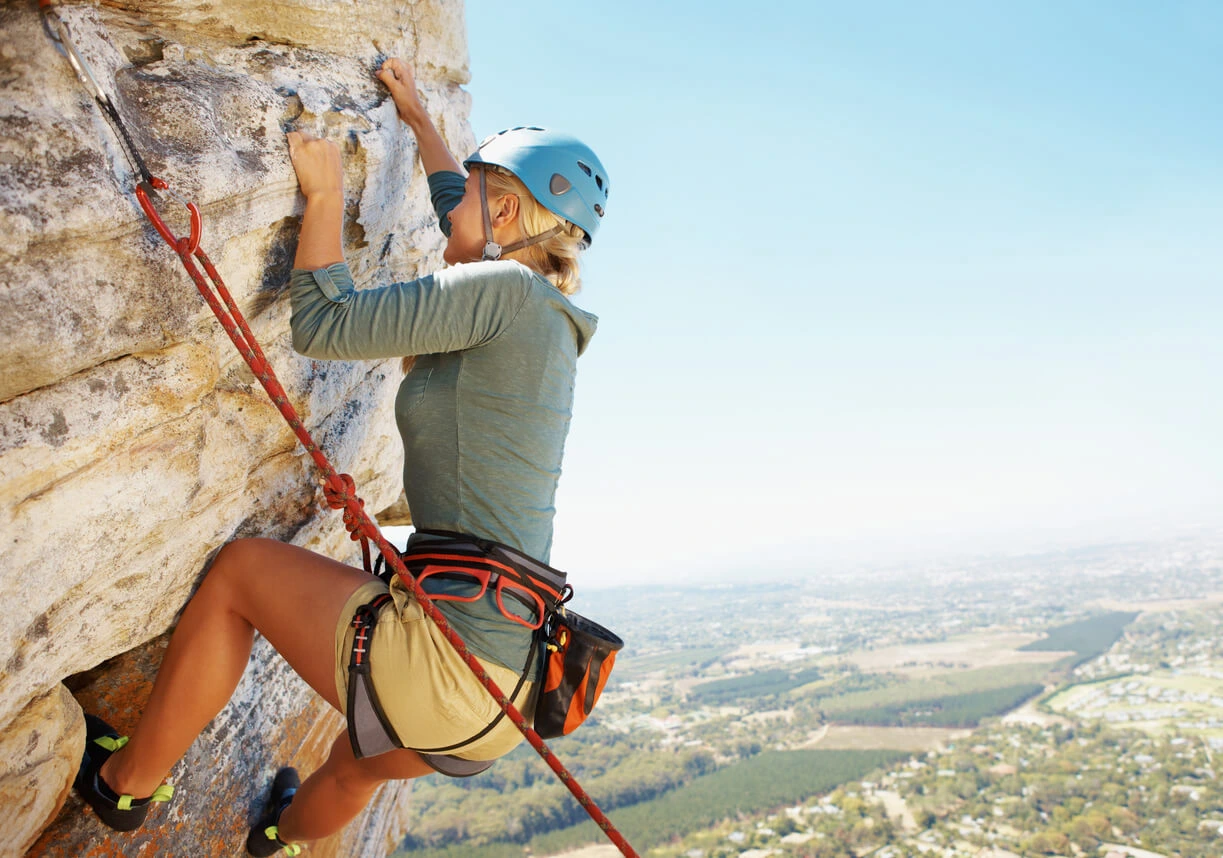
Rock climbing is a rigorous test of your full mental and physical capabilities. If you’re a regular climber, thoughts like ‘this is so tough’, ‘I can’t do this’, or ‘What if I don’t make it?’ have no doubt crept into your head.
Rock climbing injuries can be common and you'll want to do everything you can to stay injury-free.
We've spoken with rock climber Callum Muskett, specialising in trad and alpine climbing, to narrow down the five most common rock climbing injuries and how you can avoid them.
1. Finger pulley injuries
The harder you train and the more difficult climbs you start taking on, the more likely you are to suffer this injury.
It occurs when you overload the tendon of your finger with your body weight, often when you’re crimping during a climb. That’s why it’s also known as ‘climber’s finger’.
A finger pulley tear is typically the result of gripping a small hold with your fingertips and using an excessive amount of force. This reiterates the point above about this injury being linked to climb difficulty—as you move up the grades, the holds will get smaller and you run the risk of sustaining injuries like this.
You’ll know you’ve suffered this injury if you hear and feel a pop, followed by pain and swelling. The middle or ring fingers tend to be most vulnerable to this type of injury, and the most acute pain is in the base of the finger.
The A2 pulley is most commonly torn when rock climbing—this is the tendon located in the first finger segment (proximal phalanx) closest to the palm. The A4 pulley is also vulnerable to tears when rock climbing.
Calum Muskett, notes: “Finger injuries such as pulley tears have got to be the most common form of rock climbing injuries. The pulley tendons are avascular, meaning they don’t get much blood flow, and can take a while to heal. This injury appears to be common when people start climbing later in life and/or ramp up the training too quickly.”
Prevention tips
Painful as it is, there are several steps you can take to lower the risk of suffering a finger pulley injury.
You should conduct a thorough warm-up before climbing, especially if you’re an outdoor climber. This warm-up could take the form of jogging, cycling, or jumping rope for around 20 to 30 minutes and can help increase the flexibility of the finger flexor tendons, which allows them to absorb more force.
You should also carry out some dynamic stretches followed by a few easy climbs to practise your grip. And don’t forget about static stretches, such as the prayer stretch, or finger flexor stretch.
Paying attention to your footwork and climbing with your hips pressed into the wall will help you avoid over-gripping and reduce the stress you place on your pulleys.
Another useful strategy that will help you avoid this injury is to build up your finger strength, enabling you to grip smaller pockets. You can do this by hang boarding (if you’re an intermediate climber), purchasing a hand and finger exerciser, or squeezing a stress ball. There are many options available to you.
The final tip, which applies to every injury in this article, is to avoid overloading yourself and listen to your body if you feel a tear or pull. Putting unnecessary stress on an already torn pulley may prevent you from climbing for up to six months in the most extreme cases.
2. Tendonitis
If you don’t know this already, tendons are the cords that attach muscle to bone. As such, rock climbing can cause inflamed tendons in multiple parts of the body, such as the shoulders, forearms, and elbows.
The tell-tale signs that you’ve got tendonitis are:
- a dull aching pain
- swelling
- difficulty moving the joint, lifting, and lowering your arm
Rock climbers are at risk of sustaining this injury because they’re constantly pulling with the same muscles (lats, shoulders, biceps, and forearms) and performing repetitive movements. This inevitably puts a huge amount of strain on your tendons in the areas of the body listed above.
This explains why terms like climber’s elbow and tennis elbow are most synonymous with rock climbing – because the muscles surrounding the elbow are most prone to inflammation. However, you can minimise the risk to them and reduce the likelihood of sustaining tendonitis by following a few simple exercises.
Prevention tips
You should perform both dynamic and static stretches if you want to avoid tendonitis.
These serve different functions in loosening the muscles and tendons most at risk from climbing. Dynamic stretches will get the blood flowing to your muscles and tendons, while static stretches will prevent your muscles from tightening up when you climb.
Here’s a great dynamic warm-up you can do in less than 10 minutes:
As for static stretches, there are a range that you can perform at home without equipment. The most important stretches include forearm supination/pronation and the wrist/finger stretch.
Here are another couple of examples:
- Straighten your arm in front of you as much as you can, bend your wrist towards your chest, palm facing you. Hold this position for 5 to 10 seconds, or as much as you can handle it. This will stretch your extensors.
- Straighten your arm in front of you, palm facing outward, gently pull the back of your hand towards your chest. Hold this position for 5 to 10 seconds. This will stretch your flexors. If you own a dumbbell, this will give you more options in terms of the number of exercises you can do.
3. Shoulder injuries
Climbers are vulnerable to shoulder injuries because they extend their arms over their shoulders and reach overhead to perform certain movements.
Doing this can lead to such injuries as rotator cuff tears. The rotator cuff is a group of muscles and tendons located at the head of the humerus (upper-arm bone) and keeps it in the shoulder socket. Moving your arm above your shoulder repeatedly causes the rotator cuff to tear—and as you can imagine, it’s not pleasant.
Considered the most common rock climbing injury, a rotator cuff tear consists of aching, sharp pains at the top of the shoulder. Other symptoms of this injury include:
- pain at rest, particularly if you’re lying on the affected shoulder
- trouble raising your arm
- unable to lift certain objects with the same ease as normal
- a clicking or popping noise when you move your shoulder
Another common shoulder injury associated with rock climbing is a SLAP (Superior Labrum Anterior and Posterior) lesion tear, also known by its official term labrum tear. Ask any climber who’s suffered this injury, and they’ll tell you how painful it is.
It occurs when the top of the labrum—a type of cartilage found in the shoulder joint—is torn. The chief cause of this injury is traumatic or repeated force to the shoulder, through dynamic climbing, for instance.
Calum Muskett: “I’ve been unfortunate to have poor shoulder health, with a 40% SLAP lesion tear and regular subluxation of my shoulder. Despite MRI scans and consultation with a surgeon, I’ve decided to go for the non-invasive rehabilitation through self-management, with good results. Whilst shoulder injuries are painful and acute, I’ve found the recovery process relatively short.”
Prevention tips
As you’d imagine, technique plays a major role in avoiding shoulder injuries. A number of movements can lead to shoulder impingement, such as climbing in a chicken-wing position, mantling, and jamming hand cracks with your thumbs facing downwards. So, if you’re executing these movements, you need to know what you’re doing. If you’re still quite new to rock climbing, you should watch as many instructional videos as possible, like the ones we’ve linked to above.
Another important factor, as with any key body part used for climbing, is muscle strength. This can be achieved through various exercises, but these involve several pieces of equipment—for example, a bench, dumbbell, gym ball, and resistance band.
The best exercises for increasing shoulder strength include internal and external rotation and the reverse fly. If you’re a gym member, you’ll be familiar with these and many other shoulder strengthening exercises.
Calum Muskett: “Climbers often have slumped shoulders, which can be counteracted by regular stretching/yoga and/or exercises such as push-ups for a non-creative solution.”
4. Wrist injuries
Climbing-based wrist injuries can take various forms.
You could lacerate the wrist by coming into contact with the rock face during a climb, or when trying to break your fall. Indeed, trying to break your fall to the ground or into a climbing wall could also cause a wrist fracture.
However, a tear to the triangular fibrocartilage complex (TFCC) is the most common wrist injury suffered by rock climbers.
The TFCC is a load-bearing structure made up of ligaments, tendons, and cartilage. Its job is to stabilise the body when your arm rotates or your hand grasps, so it’s a vital component in rock climbing.
It’s located on the pinky side of the wrist, between the ulna (forearm bone) and the wrist’s carpal bones. This diagram illustrates what we’re talking about.
A TFCC tear is split into two types. A Type 1 tear occurs when you fall and land on an outstretched hand, and a Type 2 tear is caused by the slow breakdown of cartilage in the TFCC. If you put pressure on your wrists and pull on sloper holds, you risk suffering this injury.
These are the main symptoms of a TFCC tear:
- Sharp pain along the outside of the wrist
- a persistent dull ache
- swelling
- weak grip strength
- limited range of motion
- a clicking or popping sound when moving the wrist
If you tear your TFCC, the typical recovery time is four to six weeks. This injury is often treated with rest, anti-inflammatory medication such as ibuprofen, and a splint. However, in extreme cases, you may require surgery, protective support such as a cast, and physical therapy.
So, if you don’t feel like going down this route, read below for some handy advice on how to avoid a TFCC tear.
Prevention tips
The first tip may sound o is to avoid using the affected wrist if you feel any pain. All too often, climbers will attempt to power through the pain barrier, pulling on big slopers and putting more stress on the TFCC. If you do this, you run the risk of sustaining a serious injury and prolonging your recovery time. Taking time out from climbing is hard when you’re so committed to it, but your wrists will be in better nick for it.
Performing wrist extension, flexion, and rotation exercises will keep your wrists healthy. As you’ll see from clicking the link, you don’t need equipment to perform these specific exercises, but again, you’ll be able to perform a wider range of exercises if you have a dumbbell or resistance band.
As we covered in the Tendonitis section above, anything you can do to improve wrist strength will also lessen the risk of injury. A gripper is yet another piece of equipment which can help you in this area. You may even want to invest in a wrist brace or taping for that added layer of protection.
5. Ankle sprains and fractures
Of course, rock climbing injuries are not limited to the body’s upper extremities. Research has found that ankle injuries account for almost a fifth of all climbing-related injuries. What’s more, they make up a quarter of all sprain-type injuries.
You’re most likely to sprain or fracture your ankle when bouldering, for several reasons:
- you’re likely to repeatedly fall, and potentially fall from a significant height
- the crash pads used in bouldering gyms can result in ankle fractures if a climber falls and their foot lands on the outermost edge of the pad or lands between two pads
- climbers often buy shoes that are several sizes smaller than their street shoe size. This forces the foot into an inward or supinated position, leading to ankle sprains if you place a high amount of force on the ankle or fall off a boulder problem
If you fall and twist your ankle inwards, this is known as an inversion injury—a form of ankle sprain. When this happens, your foot rolls inward, which damages the ankle’s outside ligaments.
Though this sounds extremely painful, the amount of pain you’ll feel depends on the severity of the sprain.
Ankle sprains can be divided into 3 grades:
Grade 1
A minimal stretch, with no tearing. You’ll experience mild pain, swelling, and tenderness, but you’ll have no issues bearing weight. The recovery period is 1 to 3 weeks.
Grade 2
A partial tear. You’ll experience moderate pain when weight bearing or walking, as well as swelling, tenderness, and potential bruising. You’ll lose some range of motion. The recovery period is 3 to 6 weeks.
Grade 3
A full tear or rupture. You’ll experience severe pain, swelling, tenderness, and bruising. You’ll be unable to bear weight and will lose the range of motion in your ankle. The recovery period could last for several months.
Prevention tips
A Grade 1 ankle sprain is far from ideal if you’re a regular climber, but Grade 3 doesn’t bear contemplating. So, improving your lateral stability is vital if you want to avoid ankle sprains, or ankle injuries of any kind.
Numerous exercises target lateral stability and ankle proprioception (that is, your body’s ability to sense where your ankle and other limbs are in a three-dimensional space). These exercises include:
- ankle plantar flexion
- ankle eversion
- ankle inversion
- ankle dorsiflexion
As you’ll see, these exercises require a resistance band. Without sounding like a broken record, you need to get one if you don’t have one already. It’s clearly worth the investment. Perform these exercises in your free time, and you’ll have stronger ankles, better balance, and be ready to climb.
Thanks to Calum Muskett for his insights—you can follow Calum on Instagram or watch him in action on YouTube.
Specialist rock climbing insurance from Insure4Sport
Before your next climb, you may want to consider specialist climbin insurance to help financially protect you should you suffer a rock climbing injury. Get a quick online quote today.
Please note the information provided on this page should not be taken as advice and has been written as a matter of opinion. For more on insurance cover and policy wording, see our homepage.
Get a quick quote for Sports Insurance
Get A QuoteRelated Posts
Insure4Sport is a
 Insurance Services product


©Copyright Ripe Thinking Limited 2026.
Insure4Sport® is a registered trademark and a trading name of Ripe Insurance Services Limited which is Authorised and Regulated by the Financial Conduct Authority No.313411. Registered office: One Stockport Exchange, Railway Road, Stockport, United Kingdom, SK1 3SW. Registered in England No. 04507332.