
Ski slope colours explained, what they tell you and what they don't
22 October 2026

Ski slope colours show a run’s relative difficulty within a regional grading system. In France, the sequence generally goes green, blue, red, then black. Whether you ski or snowboard, the colour is a starting point: it doesn’t tell you today’s conditions or whether the run suits your skills.
You’ve opened the piste map and started planning your day. There’s a blue you like the look of, a red your friends want to try and a route back that needs a closer look. How do you make sense of it all?
Here’s what the colours mean, why the same run can feel different from one day to the next, and what skiers and snowboarders can work on before trying harder terrain.
What do green, blue, red and black ski slopes mean around the world?
In countries using the four-colour system, including France, green indicates the easiest graded pistes, followed by blue, red and black. A piste is a marked ski run. Read the resort’s own map legend before using the colours to plan your day.
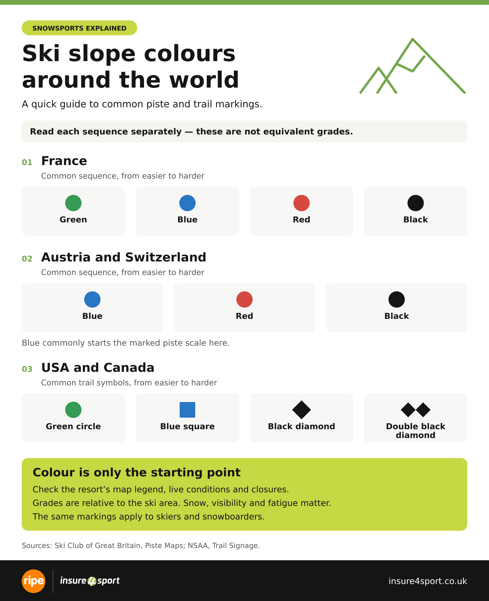
| Colour or regional marking | Broad meaning | Important qualification |
| Green in France | Easiest graded pistes | Easiest is a relative grade, not a promise of easy conditions. |
| Blue in France | A step up from green | Individual runs can still differ in layout and demands. |
| Red in France | More difficult than blue | The grade doesn't describe every section or today's snow. |
| Black in France | More difficult of these four grades | Black is a difficult grade, not a synonym for off-piste. |
| Blue, red and black in Austria and Switzerland | A commonly used sequence from easier to harder marked pistes | Don't assume a French green category will appear on the map. |
| Green circles, blue squares and black diamonds in North America | Broadly, easier through to more difficult terrain | These are local relative ratings, not direct equivalents of European colours. |
The Ski Club of Great Britain’s piste-map guide compares regional grades. Use the resort’s own map legend for local detail.
Do ski slope colours mean the same thing in every country?
No. France’s familiar green-to-black sequence isn’t a worldwide standard. Austria and Switzerland commonly start their marked piste grading at blue.
In North America, look for shapes as well as colours: green circles, blue squares, black diamonds and double black diamonds. The NSAA’s trail-signage guidance explains that difficulty is relative to the ski area. A blue square isn’t a precise translation of a European blue, and a red doesn’t have a universal diamond equivalent.
Do the same slope colours apply to skiing and snowboarding?
Yes. A run has the same grade whether you’re on skis or a snowboard. The rating describes the terrain; there isn’t a separate colour scale for snowboarders.
How it feels is another matter. You and your friends may find different things challenging. The map gives you shared information, rather than an individual assessment.
What do ski slope colours tell you, and what do they leave out?
Colours give a broad indication of relative difficulty. They aren’t a live report on snow, visibility or how busy a run is.
| What the grade tells you | What it leaves out |
| Where the run sits in the local difficulty system | Whether conditions have changed since your last descent |
| A starting point for comparing local routes | Current visibility, weather and traffic |
| A broad indication of challenge | How tired you feel or how consistently you can control your speed and turns |
| Information to read alongside the piste map | Whether the run is open and what local signs say today |
Imagine returning to a familiar blue after the weather changes. Yesterday you could see the contours clearly; today visibility is poor and the snow feels different. The colour hasn’t changed, but the experience has.
Méribel’s published guidance highlights how fatigue, visibility, snow and other slope users can change the demands of a run. Grooming—the preparation of the snow surface—is another part of the picture.
Can a blue run feel harder than a red run?
Yes. Different resort grading, changing conditions and your own experience can make a blue feel more demanding than a red you remember elsewhere.
That doesn’t make a red a suitable alternative if you’re struggling on blues. Pause the colour comparison and look at what’s making the run difficult: the conditions, the route or something you’d like help practising.
How can I progress from blue to red runs?
Develop consistent control on suitable, familiar terrain, then consider the particular red and the conditions. A lesson can help you identify useful learning priorities and discuss a suitable next step.
Progress doesn’t have to mean a different colour on the map. Smoother turns or more consistent control on your usual blue are worthwhile improvements in their own right.
How can I improve my skiing before trying red slopes?
Focus on consistent turns and managing your speed and line—the path you take down the slope. Developing parallel skiing on easier terrain can form part of that learning.
Parallel turns involve keeping your skis alongside one another as you turn. New Generation’s guide to parallel skiing explains why learning on familiar, easier slopes matters.
For example, if you’re comfortable on blues but find some turns rushed, you could focus a lesson on consistency and choosing your line. That gives you something specific to work on beyond “getting down a red”, with feedback from an instructor watching you ski.
How can I improve my snowboarding before trying red slopes?
Work on smooth, linked turns and controlling speed throughout them. Linked turns simply means joining one turn to the next, changing from one edge to the other as you travel downhill.
Snowboard Addiction’s intermediate-turn guidance focuses on smooth turns with speed controlled through the turn.
Imagine you’re happy on a familiar blue but want more control before trying steeper terrain. “How can I link my turns more smoothly here?” gives an instructor a specific starting point. Carving isn’t a test you must pass before reds, and you don’t need to match a friend’s pace.
How do I know whether I am ready for a red run?
Consider how consistently you control your speed and turns on familiar terrain, the run you’re considering and the current conditions. Confidence matters, but it doesn’t establish skill by itself.
An instructor who knows the area can watch your skiing or riding and discuss the particular run with you. That offers more useful feedback than counting days on snow or relying on friends to say you’ll be fine. Méribel’s progression guidance also highlights the value of local instruction.
How can I choose a run using more than its colour?
Read the colour alongside the full route and current resort information. Before committing to a lift or descent, consider:
- The map legend and live status: what do the markings mean here, and which runs are open?
- The complete route: does an apparently straightforward start connect to harder terrain?
- The return: how will you get back, and are alternative routes or lift returns available?
- Conditions and energy: has visibility changed, and are you becoming tired?
- Signs and closures: follow local restrictions, even on a run you know.
The FIS Code of Conduct applies to skiers and snowboarders. It calls for control suited to personal ability, terrain, snow, weather and traffic, as well as respect for signs.
Planning somewhere closer to home? Our guide to skiing in Scotland introduces the destinations; check each centre’s own map and current updates when planning a visit.
Frequently asked questions
Which ski slope colour is easiest?
Green is generally the easiest graded piste in four-colour systems such as France’s. Some countries, including Austria and Switzerland, commonly use blue as their easiest marked piste grade. Check the local map legend: the easiest available grade doesn’t guarantee that a run suits every beginner or today’s conditions.
Does a black run mean off-piste?
No. A black grade describes difficulty; off-piste refers to terrain outside marked pistes. A black run can be a marked piste, and its colour alone doesn’t tell you how its surface has been prepared. Check the map, local markings and current information rather than treating black and off-piste as interchangeable.
How long does it take to move from blue to red slopes?
There’s no reliable universal timeframe. Your existing skills, practice, tuition and the conditions all affect progression. Focus on developing consistent control rather than reaching a colour by a particular day. Individual feedback can help you understand what to work on next and which terrain is appropriate.
Specialist skiing and snowboarding insurance by Insure4Sport
Find out more about specialist skiing insurance and snowboarding insurance by Insure4Sport.
Please note the information provided on this page should not be taken as advice and has been written as a matter of opinion. For more on insurance cover and policy wording, see our homepage.
Get a quick quote for Sports Insurance
Get A QuoteRelated Posts


Insure4Sport is a
 Insurance Services product


©Copyright Ripe Thinking Limited 2026.
Insure4Sport® is a registered trademark and a trading name of Ripe Insurance Services Limited which is Authorised and Regulated by the Financial Conduct Authority No.313411. Registered office: One Stockport Exchange, Railway Road, Stockport, United Kingdom, SK1 3SW. Registered in England No. 04507332.