
Pickleball vs padel: What’s the difference?
28 November 2025
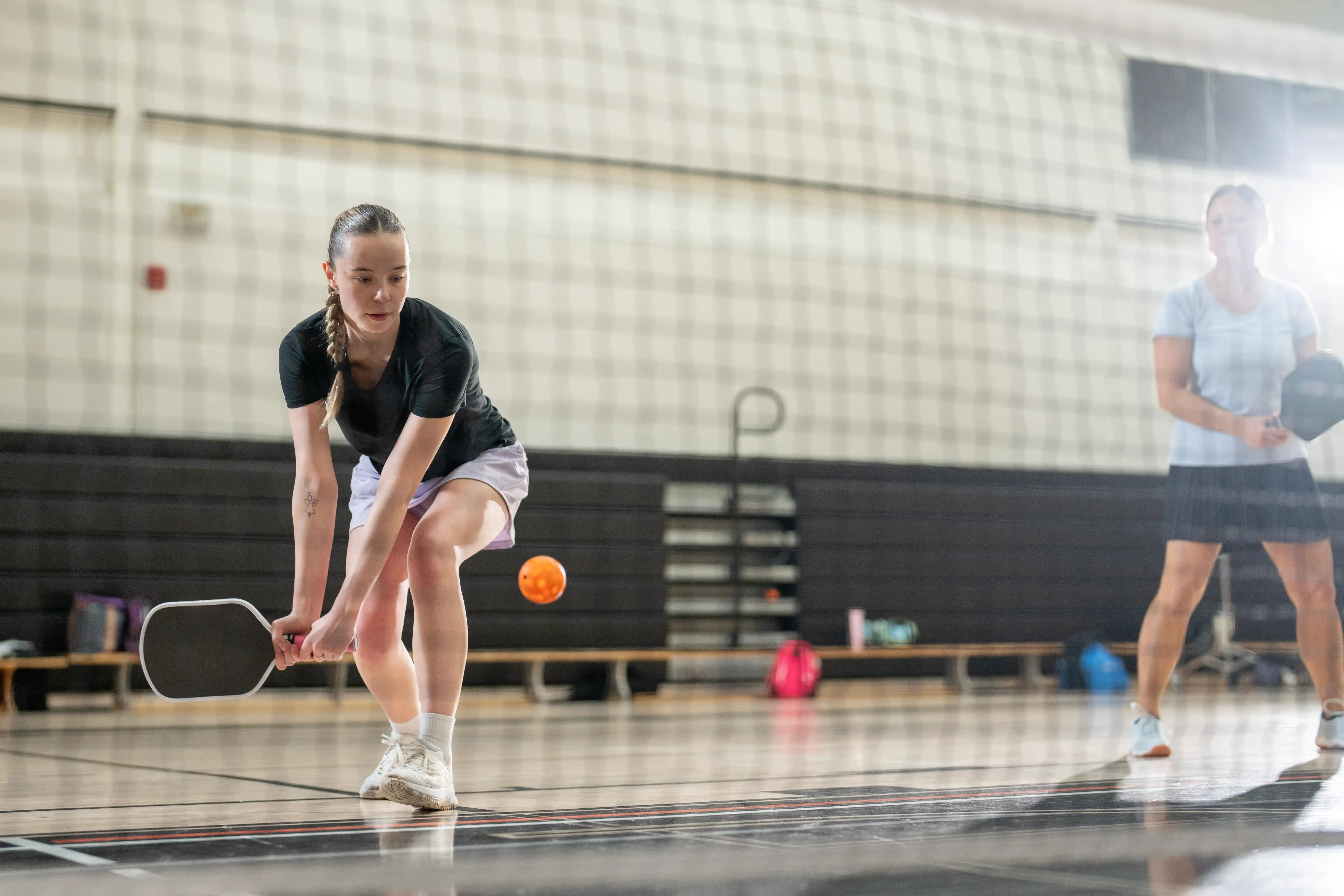
When comparing pickleball and padel, there are many different aspects to consider, from the rules and court sizes to popularity and difficulty.
Here we’ll look at the main differences between the two sports, so you can find out which one you may be more suited to.
What is pickleball?
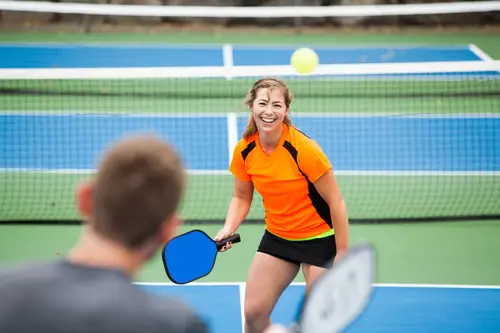
Pickleball is an increasingly popular paddle sport that combines elements of tennis, badminton, and table tennis.
It is fun, social, and easy to learn. Pickleball is played on a smaller court than other racket sports and has a low net. Players use solid paddles and a lightweight, perforated plastic ball that travels more slowly than a tennis ball, making the sport perfect for beginners while remaining exciting for advanced players as well. Games can be played in singles or doubles. Doubles tends to be most popular thanks to the energetic rallies and the teamwork required.
One of pickleball’s unique features is the “kitchen”, a no-volley zone that prevents players from hitting the ball close to the net. This rule encourages longer points, thoughtful shots, and clever placement rather than relying purely on power. Pickleball favours quick reflexes, smart positioning, and tactical decision-making, which is why it appeals to players of all ages and fitness levels.
What is padel?
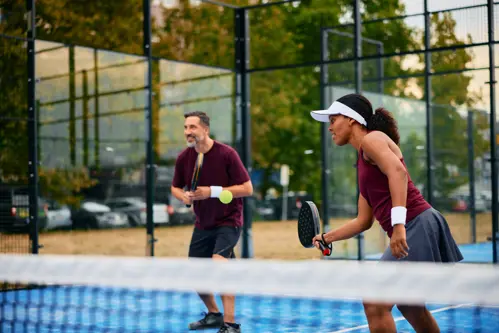
Padel is a fast-paced, social sport played on an enclosed court, blending the energy of tennis with the strategy of squash. Most commonly played as doubles, padel uses solid, perforated paddles and a low-compression tennis-style ball, making the game ideal for beginners. A padel court is surrounded by glass and mesh walls, which keep the ball in play and allow players to use rebounds. This adds a unique element that makes padel different from other racket sports.
One of padel’s most appealing features is its blend of power, placement, and anticipation. While higher fitness levels can be beneficial, the sport also relies on timing, teamwork, and effective positioning. Rallies tend to be long and engaging as the walls keep the ball moving, encouraging creative shots, angled rebounds, and coordinated teamwork.
Padel is also known for being kind on joints due to the smaller court size and predictable movements, making it suitable for a wide range of ages and fitness levels. Its social atmosphere and exciting gameplay have contributed to its rapid increase in popularity, especially in Europe and Latin America, where it has become one of the fastest-growing racket sports.
Pickleball vs padel: Rules
When comparing the rules of padel and pickleball, several key differences are worth noting.
Court and walls
Padel is played on an enclosed court with glass and mesh walls, whereas pickleball is played on an open court that looks like a small tennis court. This means that the ball can stay in play when it hits a wall during a game of padel, but it will be out of play if it goes off the court in pickleball.
Volleying
In padel, players can volley from anywhere, provided they’re behind the net. Pickleball has a seven-foot no-volley zone on both sides of the net called the “kitchen”, and players aren’t permitted to hit volleys while standing inside it.
Serving
During a game of padel, serves must be made underhand from waist height, and the ball must be bounced before serving. The serve must land in the diagonal service box, and two serves are allowed. Serving is also underhand in pickleball, but the ball should be hit without a bounce, unlike in padel. The ball must land in the diagonal service box, and only one serve attempt is allowed.
Scoring system
Padel uses traditional tennis scoring – for example, 15–30–40–game, sets, tiebreaks – while pickleball uses rally scoring rules.
Team format
Padel is almost always played in doubles in official play, while singles and doubles are both common in pickleball.
Ball in play
The padel ball can bounce once on the ground and then off the walls before being returned, and players can also hit off their own walls. In pickleball, the ball must land within the court boundaries, and no rebounds off the walls are allowed.
Equipment
In padel, players use a solid, perforated racket with no strings and a low-compression ball that’s similar to a tennis ball. Pickleball players use a lightweight paddle made from composite materials and a hollow plastic ball with perforations.
Double-bounce rule
Pickleball has a double-bounce rule where the serve must bounce once on the return, and the ball must bounce again before the serving team can volley. There is no double-bounce rule in padel, and volleying is allowed immediately after the serve is returned.
Pickleball vs padel: Courts
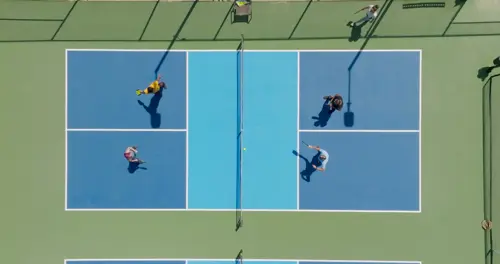
There are a few key differences between pickleball and padel courts:
Court size
- Padel – 20 x 10m
- Pickleball – 13.41 x 6.1m
Walls
- Padel – Fully or partially enclosed with glass walls and mesh
- Pickleball – Open court with no walls
Net height
- Padel – 88cm at its centre
- Pickleball – 86cm at its centre
Playing surface
- Padel – Usually artificial turf for traction
- Pickleball – Hardcourt surface, like asphalt or acrylic
Court markings
- Padel – Markings include a centre service line, service boxes, and a baseline
- Pickleball – Distinct no-volley zone (kitchen) and simpler lines compared to padel
Surrounding area
- Padel – Has a full cage around the court.
- Pickleball – Open court with an optional perimeter fence
Pickleball vs padel: Popularity
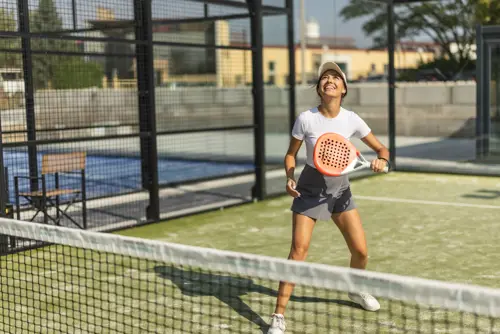
At present, padel is more popular than pickleball in the UK. Recent data suggests that there are now just over 1,000 padel courts across the country, and the number of padel players has increased from 15,000 in 2019 to approximately 400,000 in 2024.
Pickleball is also growing rapidly in the UK, according to statistics, with more than triple the number of players compared to 2020 and over 270 clubs in the UK.
Pickleball vs padel: Difficulty
Whether padel or pickleball is more difficult to play depends on what type of skills you find challenging. However, padel is generally thought to be more difficult than pickleball for beginners for the following reasons:
- The walls are in play, so you need to learn rebounds, angles, and timing
- The court is larger, requiring more movement and positioning
- Shots are more varied
- The game is typically faster
Pickleball is easier to start with but becomes more challenging at higher levels, making it ideal for both beginners and more experienced players.
- Its smaller court and simpler rules make it great for beginners
- A slower ball means players learn control quickly
- There are fewer shot types and no wall rebounds
Specialist padel and pickleball insurance through Insure4Sport
Whether you play padel or pickleball, both sports can come with risks, which is why you may want to consider getting specialist padel and pickleball insurance.
Specialist padel and pickleball insurance through Insure4Sport can help provide financial protection should you suffer an injury or injure another player or their property while you play. Find out more about specialist padel and pickleball insurance or get a quick online quote today.
Please note the information provided on this page should not be taken as advice and has been written as a matter of opinion. For more on insurance cover and policy wording, see our homepage.
Get a quick quote for Sports Insurance
Get A QuoteRelated Posts
Insure4Sport is a
 Insurance Services product


©Copyright Ripe Thinking Limited 2026.
Insure4Sport® is a registered trademark and a trading name of Ripe Insurance Services Limited which is Authorised and Regulated by the Financial Conduct Authority No.313411. Registered office: One Stockport Exchange, Railway Road, Stockport, United Kingdom, SK1 3SW. Registered in England No. 04507332.