
8 cable chest exercises for better results
10 December 2025
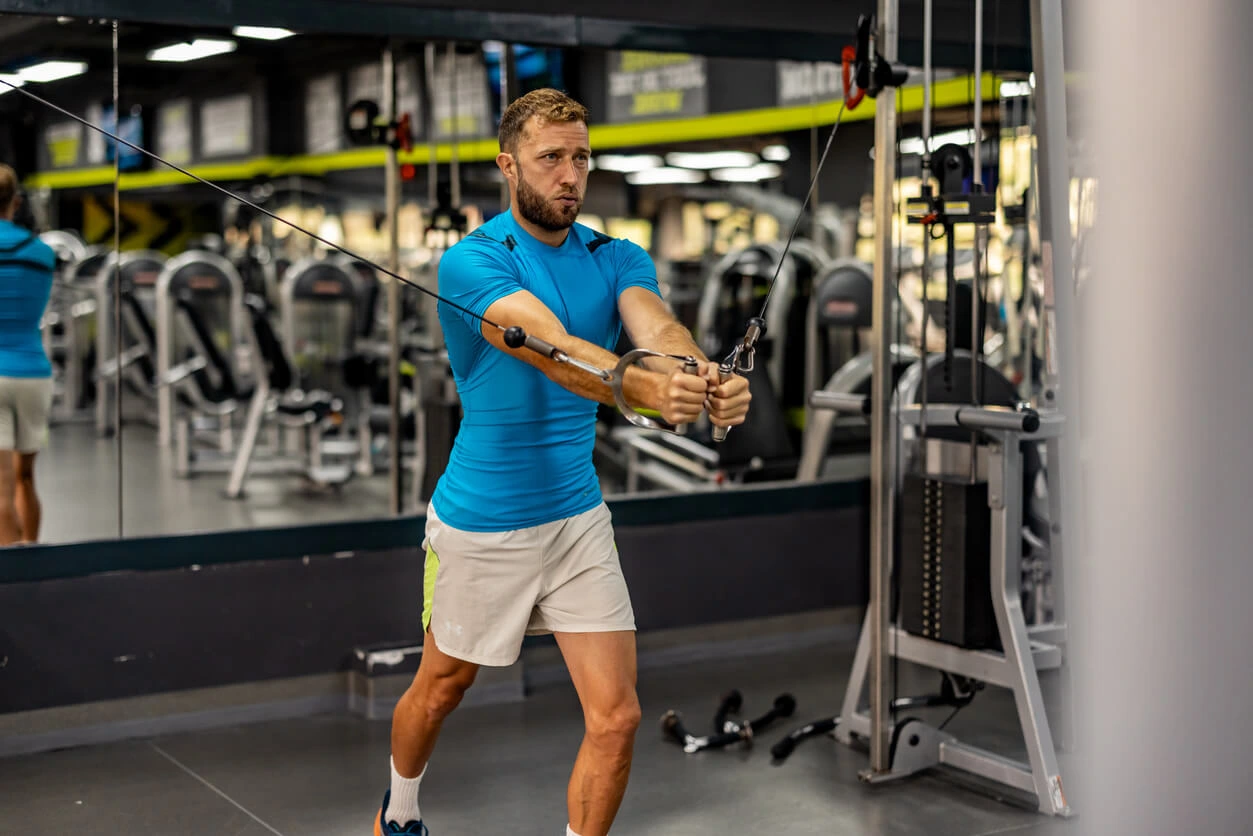
Cable chest exercises are ideal if you’re looking to build your chest width, improve definition, create chest separation, and boost functional pushing power.
Here, we discuss the anatomy of the chest and share eight cable chest exercises for better results, alongside a workout plan example. We also highlight how to stay safe when doing these exercises in the gym.
The anatomy of the chest
The main parts of the chest are the pectoralis major and pectoralis minor. Cable chest exercises challenge both through applying constant, multi-directional tension.
The pectoralis major – the large muscle at the front of the ribcage – has two major regions: the clavicular and sternal fibres. These fibres run in different directions, and adjusting cable height allows you to target each region. Low-to-high movements work the clavicular fibres, helping to lift and shape the upper chest, while high-to-low movements follow the natural downward orientation of the sternal fibres.
The pectoralis minor – a smaller triangular muscle that stabilises the scapula – sits beneath the pectoralis major. Cable exercises, especially standing presses and fly variations, engage the pectoralis minor indirectly by requiring shoulder blade control and resisting the cable’s constant pull.
Supporting muscles also play crucial roles during cable chest exercises. For example, the anterior deltoids assist in pressing motions, while the serratus anterior helps to maintain proper scapular glide, particularly during deep fly stretches. The triceps are also involved when doing pressing-based cable movements.
Together, these muscles benefit from cables because the resistance never drops, allowing continuous tension. This results in stronger contraction, improved muscle activation, and balanced development across the whole chest.
8 cable chest exercises
There are many cable chest exercises you can add to your workout, all of which can help you achieve better results in the gym.
Standing cable chest fly
The standing cable chest fly is an isolation exercise using two high pulleys to target the entire chest, especially the inner and mid-pecs. This exercise helps to build chest width and inner chest definition, improve chest symmetry, and shape the pecs
For the standing cable chest fly, you’ll need to:
- Set both pulleys at (or slightly above) shoulder height
- Step forward with a staggered stance
- With a slight elbow bend, bring your hands together in front of you
- Slowly return until you feel a stretch in your chest
Low-to-high cable fly
This cable chest fly variation targets the upper chest through simulating an incline motion. This exercise is ideal if you’re looking to build your upper chest line, enhance upper pec lift, and achieve more definition in your clavicle area.
For the low-to-high cable fly, you’ll need to:
- Set the pulleys at the lowest setting
- With your palms facing up, sweep your hands upward in an arc until they meet at chest height
- Keep your elbows slightly bent and avoid using your shoulders
High-to-low cable fly
The high-to-low cable fly is another cable chest fly variation. This exercise specifically targets the lower chest and works in a similar way to a decline press. Through doing this exercise, you can expect to develop your lower pec shelf, add depth and fullness, and define your bottom chest line.
For the high-to-low cable fly, you’ll need to:
- Set pulleys at the highest setting
- Bring your hands down and together near your belt line
- Maintain a controlled tempo with a slight elbow bend
- Standing cable chest press
The standing cable chest press is a standing alternative to the bench press using cable tension. You should add this exercise to your workout if you’re looking to strengthen your entire chest and boost functional pushing power
For the standing cable chest press, you’ll need to:
- Set the pulleys at mid-chest height with a handle in each hand
- Step forward with your elbows at 90 degrees
- Press your arms forward until they’re fully extended
- Slowly return to start
Single-arm cable chest fly
The single-arm cable chest fly is a unilateral fly that increases focus and fixes muscular imbalances. This exercise improves chest symmetry and helps to highlight inner chest definition.
For the single-arm cable chest fly, you’ll need to:
- Stand sideways to the cable stack with a handle in the hand furthest from the machine
- Perform a fly motion from wide to centre
- Repeat on the other side
Cable bench press using a bench
This chest exercise is a cable version of the bench press with constant tension throughout your full range. It builds strength and mass in the chest and is a great substitute when dumbbells are unavailable.
For this cable chest exercise, you’ll need to:
- Place a bench in the middle of the cable station
- Set pulleys low
- Lie back and press the handles upward like a dumbbell press
- Lower slowly with your elbows at 45°
Cable crossover
The cable crossover is a high-intensity chest isolation exercise that emphasises the inner chest squeeze. It adds inner pec definition and helps to create a chest separation.
For the cable crossover, you’ll need to:
- Set the cables at high or mid-height
- Step forward and pull the handles down and across your body, crossing your wrists slightly
- Slowly return to the stretched position
Cable iron cross
The cable iron cross is a more advanced fly performed with deeper stretch and a wide arc. Add this exercise to your chest workout if you’re looking to build thickness in your lower and mid pecs and achieve muscle hypertrophy.
For the cable iron cross, you’ll need to:
- Set the pulleys high
- Step forward until the cables pull your arms wide apart
- Pull your hands together in front, keeping your arms straight but not locked
- Control the stretch at the bottom
Cable chest workout plan
Combining these cable chest exercises into a workout plan can help you achieve better results in the gym over time. Try the following plan next time you’re training and make adjustments where needed.
Warm-up (3–5 minutes)
Light cable chest fly: Two sets of 15–20 reps
Main workout
- Cable bench press: Four sets of eight to 10 reps
- Standing cable chest press: Three sets of 10-12 reps
- Standing cable chest fly: Three sets of 12-15 reps
- High-to-low cable fly: Three sets of 12-15 reps
- Low-to-high cable fly: Three sets of 12-15 reps
- Cable crossover: Two to three sets of 15-20 reps
- Cable iron cross: Two sets of 12–15 reps
This cable chest workout will take around 45 minutes to complete, depending on how many rest breaks you take.
Within four to eight weeks, you’ll start to notice improved chest fullness, enhanced upper and inner-chest definition, stronger pushing strength, and better muscle symmetry.
Safety tips for cable chest exercises
As with all exercises, it’s important to stay safe during your cable chest workout to ensure you avoid injury.
- Set the pulleys at the correct height – Incorrect cable height can make you move unnaturally
- Start with a light weight to warm up – Cables provide constant tension which can overload your muscles if you haven’t warmed them up
- Maintain a slight bend in your elbows – Locking out your elbows can increase the risk of elbow and shoulder injuries
- Keep your core engaged – Arching while doing cable chest exercises can lead to lower back strain
- Use a controlled tempo – Fast, jerky movements shift load to the shoulders and biceps, away from the chest
- Don’t over-stretch – Stop when you feel a comfortable stretch to avoid rotator cuff and pec injuries
- Keep your wrists neutral – Twisting your wrists inward or backwards can strain tendons
- Use a stable stance – Use a staggered stance or shoulder-width stance which will help you to maintain your balance
- Gradually increase weight – Sudden overload can injure your pecs or shoulders
- Stop immediately if it gets painful – Cable chest exercises should create tension, not pain
Specialist gym member insurance through Insure4Sport
If you’re considering trying this cable chest workout for yourself in the gym, you might want to consider specialist gym member insurance. This insurance offers protection when using weights, cardio machines, and taking part in classes, giving you peace of mind when working out.
Get an instant online quote today.
Please note the information provided on this page should not be taken as advice and has been written as a matter of opinion. For more on insurance cover and policy wording, see our homepage.
Get a quick quote for Sports Insurance
Get A QuoteRelated Posts
Insure4Sport is a
 Insurance Services product


©Copyright Ripe Thinking Limited 2026.
Insure4Sport® is a registered trademark and a trading name of Ripe Insurance Services Limited which is Authorised and Regulated by the Financial Conduct Authority No.313411. Registered office: One Stockport Exchange, Railway Road, Stockport, United Kingdom, SK1 3SW. Registered in England No. 04507332.