
UK Attitudes Towards Women in Sport
28 February 2023
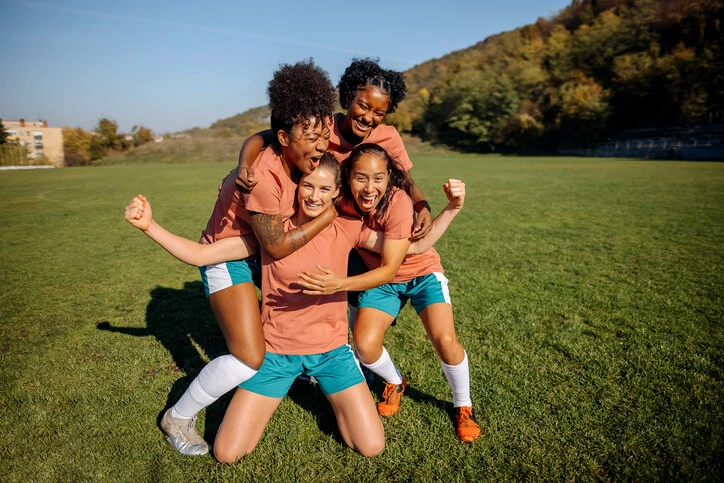
It’s undeniable that attitudes towards women in sport are shifting. Following the Lionesses’ historic Euro 2022 win, their World Cup final appearance in 2023, and their Euro 2025 triumph, women’s football has become a permanent fixture in mainstream sporting culture. Attendance in the Women’s Super League continues to hit record highs, with matches selling out at major stadiums. The Euro 2025 final attracted over 12 million UK viewers, showing that public interest is here to stay.
But away from elite football, what is the current state of play for women’s sport in the UK? How much inequality still lingers? How rife is everyday sexism in sport, both at a professional and a grassroots level? Do girls feel truly empowered to take up – and stick with – sport from a young age? And crucially, are we making any headway when it comes to championing women in sport?
Women in sport: research
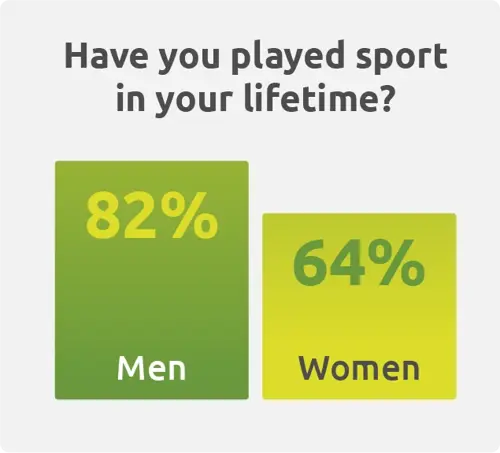
We carried out a nationally representative survey of 2,011 UK residents across 22 sports, looking at opinions on a range of issues, from the role of female pundits to how often Brits watch women’s sport on TV. We delved into long-held stereotypes of what constitutes a “male” vs a “female” sport. And we explored why 82% of men have played a sport in their lifetime compared with just 64% of women.
We then compared the findings to similar research we carried out in 2018, to explore if we’re making progress when it comes to gender parity within sport at all levels.
What was clear is that, despite some clear progress being achieved, there’s still a long way to go. Let’s delve into the details.
Sexism in sport is still rife
Overall, survey respondents acknowledged that inequality exists within sport, with 77% of people agreeing this is the case.
Interestingly, though, 80% of women said there is inequality in sport, vs 74% of men, showing differing perceptions even amongst those who agree there is an issue.
We gathered a snapshot of comments from those who don’t believe there is gender inequality in sport and uncovered a range of troubling views on the topic:
- Most female sports are really poor quality
- There is a huge gulf in skill levels. The men are way better and deserve more money
- My local men’s first team could beat the England ladies’ team quite easily
- Women get more than they deserve
- Women should play sport that is suited to them, like the egg and spoon race!
- The advancement of the women’s game has been forced upon people
- Whatever sport men are interested in, women will want to be involved too, for some reason
- Women are beginning to take over, they are headlining a lot of programmes, mainly making stupid comments or giggling all the time
- Women should not be paid anywhere near as much as male sports stars
- Women are getting more now – they’re getting special treatment!
Women in sport: viewing habits
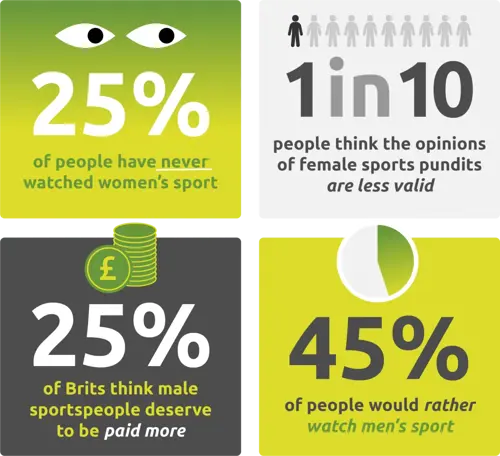
A quarter of respondents told us they had never watched women’s sport, compared to just one in 10 people who have never watched men’s sport. These figures have improved significantly since we carried out similar research in 2018, when a huge 64% of people said they had never watched women’s sport.
Almost half (45%) of people prefer to watch men’s sport – and for male respondents, this figure increases to 60%. A further 45% of people have no preference, and just one in 10 prefer to watch women’s sport.
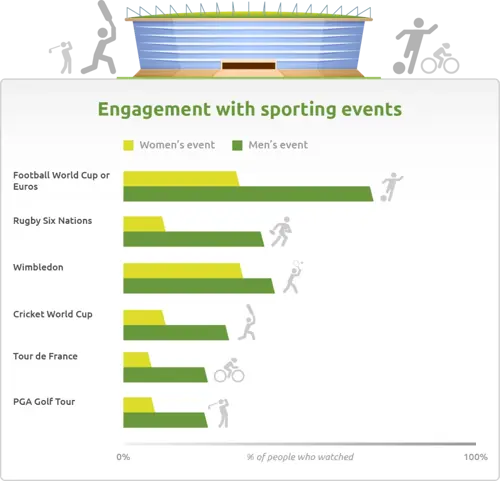
Perhaps unsurprisingly, of the 22 sports outlined in our survey, the men’s version is more likely to be watched in every single case.
The least viewing bias was found in tennis – 44% of people watched men play at Wimbledon, while 33% watched their female counterparts. The highest bias, meanwhile, is in football. A huge 72% of people have watched a men’s major football tournament such as the World Cup or Euros, vs 33% who have watched a women’s version.
Finally, it’s not just women on the pitch who are discriminated against. Almost one in 10 people said that the opinions of female pundits are less valid than their male counterparts. This view was most prevalent amongst respondents aged 55+. Encouragingly, though, progress has been made in this area over the last five years; in 2018, more than a third of people said that female pundits should get less airtime.
The gender pay gap in professional sport
Although recent BBC analysis found that 83% of sports now reward men and women equal prize money, a significant gender pay gap still exists. This runs into the millions for some sports. The average Women’s Super League player earns £47,000 a year, for example, compared to the inflated salaries commanded by male Premier League players, an average of around £5million, or 100 times more.
In addition, none of the athletes in the Forbes 2025 10 Highest Paid Athletes List were women.
Despite this clear discrepancy between men and women doing the same job, a quarter of the people we surveyed agreed that male sportspeople deserve to be paid more than women. This rises to 35% amongst men.
A common argument for pay disparity is that male sports attract a greater audience and, therefore, more commercial opportunities than their female equivalent. However, female footballers almost doubled the viewership during the 2025 Women’s Euros compared to 2022. The 2022 final had already drawn the highest audience of any Euro final in history, showing an appetite among the public that commissioners should support. More than half (58%) of people in our survey said that women’s sport should have equal TV coverage to men. This rises to 66% of female respondents.
Women in sport: inequality at grassroots
With discussions around women in professional sport now much higher on the agenda, it can be easy to forget the importance of encouraging female participation in sport at the grassroots level.
Whether at an amateur level, in a local league or just amongst friends as a hobby, getting active through sport plays a vital role in maintaining good public health – both physical and mental. A thriving grassroots scene has also been proven to deliver a range of benefits to society, bringing people together and building community spirit.
However, we found that men are disproportionately playing sports in their day-to-day lives, with 82% of men having played a sport in their lifetime vs just 64% of women. Strikingly, the only sports women are more likely to participate in than men are tennis and swimming. Half of men said they have played football to keep fit, vs just 20% of women.
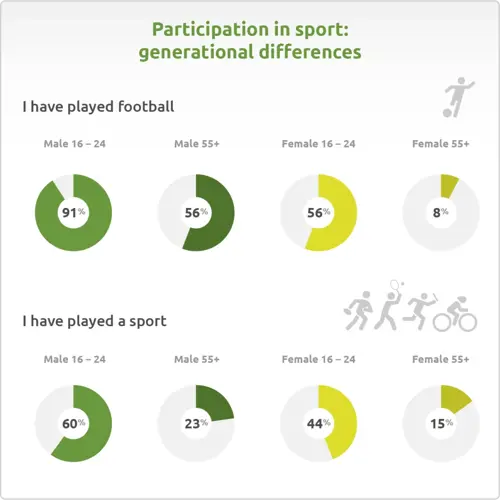
But this attitude is changing. When looking at how many people have considered playing sport – in particular, football – a generational pattern emerges. Whilst just 8% of women aged 55+ have considered playing football before, 56% of women aged 16-24 have done so. This compares to 56% of men aged 55+ and 91% of men aged 16-24. The gap, therefore, appears to be closing amongst younger female participants, undoubtedly helped by positive role models in the England women’s football squad.
Why are women put off playing sport?
To dig into this a little deeper, we asked people why they had been put off playing sport in the past. Around six in 10 (65%) of women said that sport just “isn’t their thing”, with far fewer men (41%) giving this reason.
A quarter of people stated that their fitness levels hold them back from playing sport, with a lack of self-confidence, time, and disposable income also cited as reasons for a lack of participation. Unfortunately, of course, physical sport isn’t always available to all, with almost 12% of women saying they have a disability which prevents them from playing.
One in seven women told us that they were never encouraged to play sport in school, so they haven’t played as an adult, highlighting the crucial role that school-age sport has to play in our lifelong participation levels. We have explored the state of the nation regarding children’s sport in the next section.
See our top female cricket commentators who are paving the way for women in sport.
Gender inequality in school sport
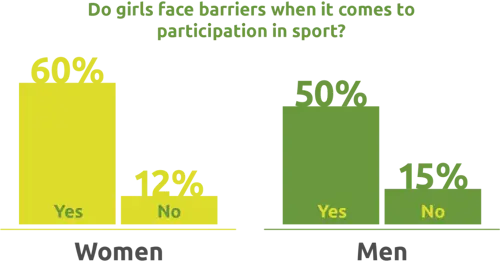
Lastly, our survey explored the level of gender inequality amongst school-age children. We found that 60% of men and 50% of women believe that girls face barriers when it comes to sports participation.
Recent statistics from the FA show that just 63% of primary and secondary-aged girls are given the opportunity to play football. So-called “male” sports, such as rugby and football, are typically only offered to boys, with girls playing so-called “female” sports such as netball and gymnastics. Enforcing these gender stereotypes is not only harmful to girls but to boys, too, and the potentially far-reaching consequences are still lacking widespread scrutiny.
Where do girls face the highest barriers to participation in sport?
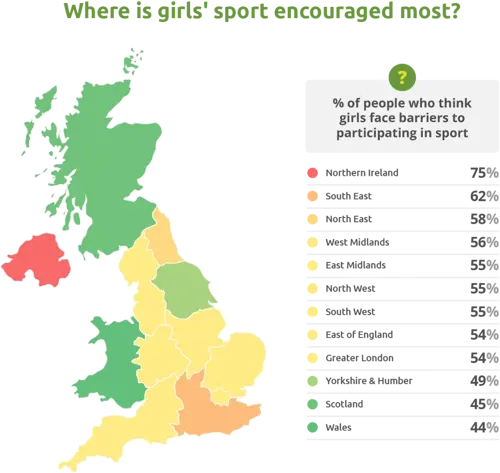
Interestingly, there were differing views on this topic across regions of the UK. When asked, “Do girls face barriers to participation in sport?”, 75% of respondents in Northern Ireland said yes. This was followed by 62% of people in the South East and 58% of people in the North East. Just 44% and 45% of people said yes in Wales and Scotland, respectively, pointing to a potentially more inclusive culture for girls’ sport in those areas.
Should girls be allowed to play all sports?
We also uncovered some surprising and outdated opinions around which sports “should” be played by boys and girls. Around half (49%) of people stated that some sports are more naturally suited to men than women, with just 35% of those surveyed agreeing that women have the potential to be as good, or better, than men at most sports.
One in six people said that girls shouldn’t be allowed to play rugby or football, with one in 10 women also agreeing with this. Concerningly, 25% of 16–24-year-olds say that girls shouldn’t play football, compared to 7% of people aged 55+.
Summary
What’s evident throughout our research is that, despite some solid progress being made regarding attitudes towards women in sport, true parity is still a long way off. The Lionesses’ historic UEFA Women’s Euro 2025 victory, watched by over 12 million people in the UK and millions more worldwide, shows just how far visibility and public interest have come vs how female players are remunerated.
Championing positive role models, increasing media coverage, and supporting grassroots participation will all support the advancement of women’s sport across the UK. We certainly hope that things will have improved again in another five years.
Methodology
Insure4Sport surveyed a nationally representative panel of 2,011 UK residents in January 2023 and analysed their responses.
Please note the information provided on this page should not be taken as advice and has been written as a matter of opinion. For more on insurance cover and policy wording, see our homepage.
Get a quick quote for Sports Insurance
Get A QuoteRelated Posts
Insure4Sport is a
 Insurance Services product


©Copyright Ripe Thinking Limited 2026.
Insure4Sport® is a registered trademark and a trading name of Ripe Insurance Services Limited which is Authorised and Regulated by the Financial Conduct Authority No.313411. Registered office: One Stockport Exchange, Railway Road, Stockport, United Kingdom, SK1 3SW. Registered in England No. 04507332.